






Schistosomiasis and fascioliasis in Angola: two months of fieldwork supported by the Semtsi Probitas Grant
Schistosomiasis and fascioliasis in Angola: two months of fieldwork supported by the Semtsi Probitas Grant
December 15, 2025
With the support of the Semtsi Probitas Grant, Dr Alejandra de Elías carried out a two-month study in Benguela province (Angola) focused on schistosomiasis and fascioliasis. The work combined parasitological diagnosis in the school population with environmental sampling in waters near the schools, to identify potential transmission focus and inform future control strategies.
What motivated your participation and how did the opportunity arise?
The opportunity came thanks to the Semtsi Probitas Grant, for which I am grateful. Since graduating in Biology, I have oriented my career towards Parasitology and the study of neglected tropical diseases (NTDs), especially schistosomiasis and fascioliasis. This project allowed me to grow personally and professionally and to witness first-hand their impact on the daily lives of communities.
What was the main objective, and why Benguela?
My stay is part of a broader project aimed at understanding the epidemiological situation of both diseases in Benguela province. I focused on estimating prevalence in the school population and identifying possible transmission foci in three municipalities: Cubal, Capupa and Jambala. Schistosomiasis is endemic in the area, and high prevalence has been reported in previous studies in Cubal. For fascioliasis there is evidence in livestock observed at slaughterhouses, but hardly any data in humans, so it was key to determine whether there is a risk to the population.
What activities did you carry out at Hospital Nossa Senhora da Paz and in the field?
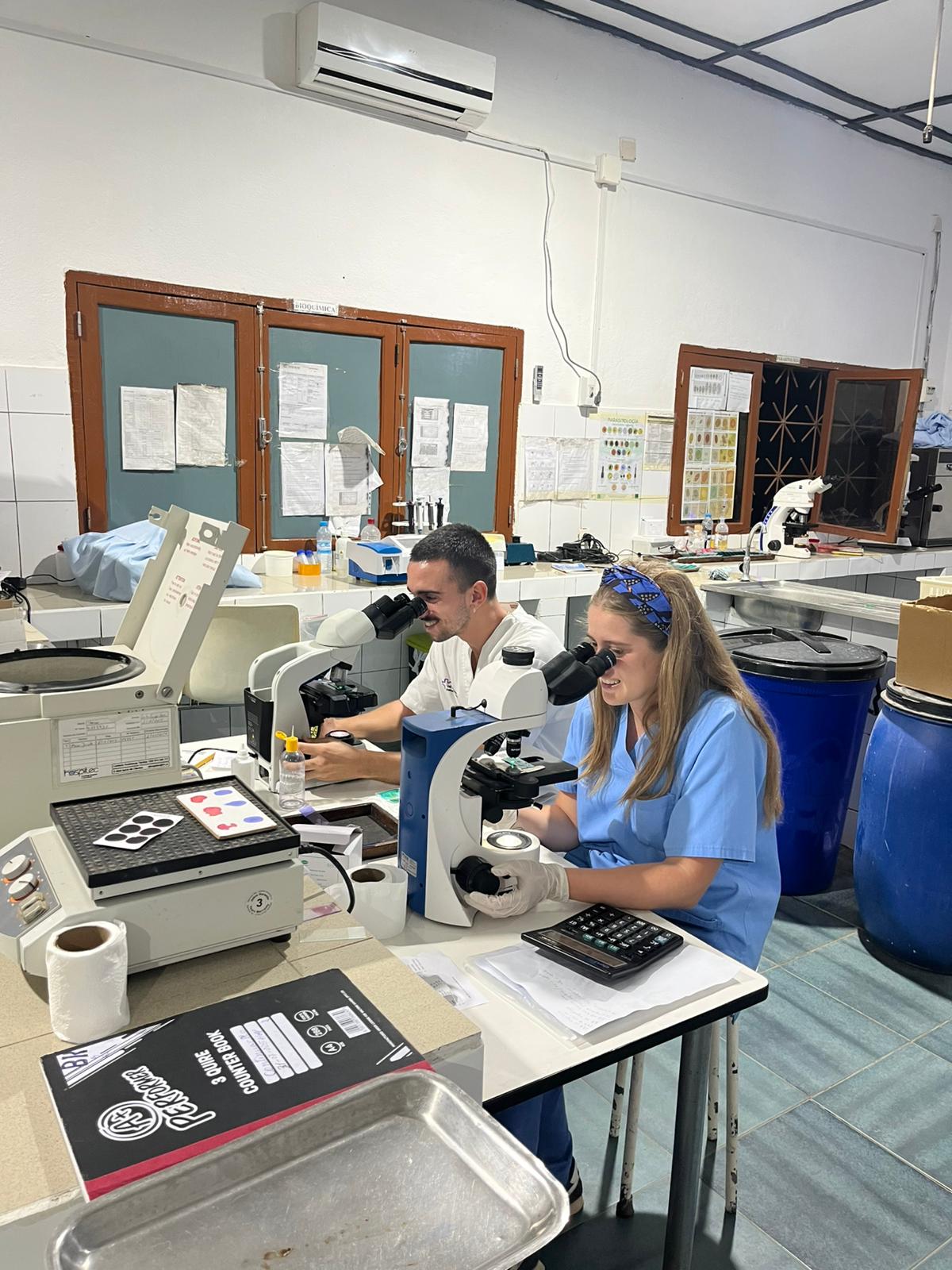
I worked in the laboratory and in the field. First, we coordinated with local authorities to obtain the necessary permits. Then, together with local teams, we organised sample collection in schools: logistics, information for the school leadership and management of parental consent. In each school we collected urine and stool samples from students, analysed them in the laboratory and delivered the results individually. In positive cases, treatment was administered according to established protocols.
What were the main logistical challenges?
Working with minors required consent from parents or guardians. We made an initial visit to each school to explain the project and answer questions; from there, the school leadership informed families and students. Getting the signed forms was not always easy: many families work in the fields in the mornings and in some areas there is no phone coverage to confirm whether consents were ready, which meant travelling to check in person. Thanks to collaboration with the schools, collection proceeded successfully.
How did the environmental sampling and environmental DNA (eDNA) analysis work?
We complemented the clinical study with sampling at water points near the schools, since both diseases are transmitted by freshwater snails. We filtered the water using membrane filters that retain DNA, extracted it and applied a specific PCR assay to detect DNA from the parasites and/or the snail vectors. Detection indicates presence and helps locate potential transmission foci. It is a relatively recent tool with great potential because it allows risk to be estimated without having to capture infected snails, which is labour-intensive and specialised.
Preliminary results?
We are still analysing the data. Preliminary observations show a high presence of urogenital schistosomiasis in the school population of the three municipalities. For fascioliasis, so far, no eggs have been detected in stool samples by direct observation; it will be important to complete the analysis with more sensitive techniques and cross-check with eDNA results.
What are the implications for public health?
Updating this information is essential to design more effective control strategies, improve deworming programmes and protect a particularly vulnerable population.
What personal and professional learnings do you take away?
On a personal level, learning to stay calm in the face of unforeseen events and to be flexible. On a professional level, appreciating the major effort involved in obtaining samples in the field, something that often goes unnoticed when working only in the laboratory. This end-to-end perspective, from collection to analysis, has significantly enriched my training in neglected diseases.
How did working in a context of limited resources and cultural diversity affect you?
It requires flexibility and creativity to overcome setbacks without compromising scientific rigour. Collaboration with the local team was essential: working with people who speak Umbundu and know community dynamics facilitates fieldwork and ensures respectful and effective research.
Any anecdote that particularly stayed with you?
At one school we were given a hen as a token of appreciation. A lovely gesture that reflects the warmth and hospitality of Angolan communities.
Any final reflection you’d like to share.
Research only truly makes sense when the results return to the community that makes it possible. Generating knowledge is important, but even more so is translating it into health education, prevention and disease control plans. Cooperation must be horizontal, based on dialogue and mutual learning with local teams.